

SMART PROJECT
SMART intends to treat pre-cancerous lesions caused by high-risk HPV and prevent their progression to oropharyngeal cancer through the development of mucoadhesive systems for oral application.
Ref: CENTRO2030-FEDER-02362200

TEAM
SMART benefits from a multidisciplinary team composed by researchers and PhD students with different backgrounds, Chemistry, Biochemistry, Pharmaceutical Sciences, Biology, Medicine, Veterinary Sciences and a company Labfit-HPRD.

SMART OBJECTIVES
The project SMART has the following objectives:
1 – To develop a mucoadhesive system incorporating functionalized liposomes enabling the localize release of anticancer/antiviral drugs for oral application and treatment of low- and high-grade intraepithelial lesions caused by HPV;
2 – To assess the scaling up risks of the mucoadhesive system aims to ensure sustainability;
3 – To characterize the different properties of the formulations aims to assess the applicability of the prototype;
4 – To evaluate microbiological and anticancer activity, as well as cytotoxicity, in in vitro models;
5 – To characterize the clinical safety and efficacy profile in vivo (K14-HPV16 transgenic model);
6 – To acess the stability and quality of the prototype;
7 – To test the application of the mucoadhesive system in human samples, namely, biopsies from patients with low and high grade intraepithelial lesions caused by HPV;
8 – To design and study the packaging (tube with applicator/cannula) of the prototype in order to assess mechanical and functional aspects, as well as stability over time;
9 – To demonstrate the semi-industrial production (pilot study) and prepare the regulatory process.
SMART TASKS
The project SMART has the following tasks:
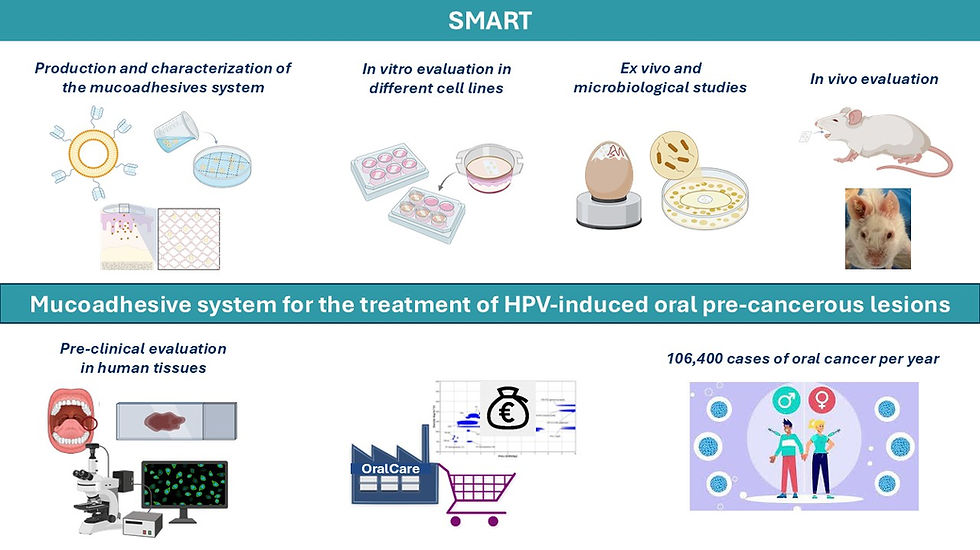
1 – Optimization, production and scale-up study of the mucoadhesive system incorporating functionalized liposomes for oral application;
2 – Technological characterization of the mucoadhesive system. To this purpose, 3 parallel tasks will be performed comprising the physical, chemical and biological characterizations (microbiological tests, anticancer activity, and cytotoxicity, in in vitro models) to validate the characteristics of the prototype for application. Additionally, security tests will be included on this task and performed by Labfit members, partner of the project SMART;
3 – Demonstration of the mucoadhesive system activity and efficacy in vivo. The proposed animal model is the genetically modified mouse (K14HPV16) that was developed by P. Oliveira at CITAB-UTAD, a partner of the project SMART;
4 – Analysis of the application of the mucoadhesive system in human samples, namely, biopsies from patients with low and high grade intraepithelial lesions caused by HPV. Volunteers with HPV positive oral lesions will be included in the study. Samples will be organized and provided by the ULSCBeira clinicians and pathologists, partners of the project SMART;
5 – Promotion and dissemination of results. The results obtained throughout the project will be disseminated in the appropriate national and international channels.
PROJECT WORKFLOW
SMART UPDATES
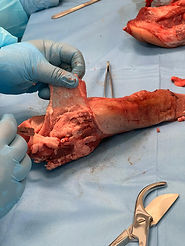
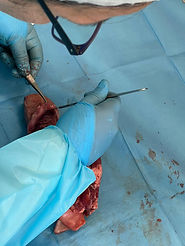
- Collection of epithelial tissue samples from distinct regions of the porcine oral cavity for subsequent experimental analyses, including permeability and bioadhesion assessments.